If you are looking for information about earlier budgets please use these links:
2009 budget, 2008 budget, 2007 budget
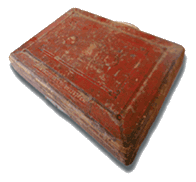
Alastair Darling delivered his third
budget on 24 March 2010, the last budget before the general election
which is widely expected on 6 May. The Chancellor had little
room to manouevre given his desire to win the election and
the poor state of the economy following the banking crisis.
Obviously bad news would have to wait until after the
election. Additionally the government's practice of
announcing tax changes a year or two in advance further tied his hands.
The result was a speech with little or no substance, leaving
this commentator wondering how it can take a hour to say so little.
This was a man with very little to say and a lot of
time in which to say it.
With a general election looming there will be very little parliamentary time available to debate and enact the Finance Bill, so it is likely to be enacted after the election. However if the election brings a change of government which parts will be enacted, and which parts destined to the scrapheap? If this happens we have been promised second budget by 25 June (50 days after the election).
This report covers the main taxes and their effect on most people. It is not intended to be a complete definitive guide to the budget. All figures are approximate. If you are looking for the definitive guide then you should try The Financial Times or one of the 'Big Four' accountancy firms. Alternatively you could try the official budget pages at HM Revenue and Customs or the government's summary on the DirectGov website.
The following tax changes have been
announced as starting in April 2010 or later. Some of these
were announced in the 2010 budget, and some in earlier budgets or in
pre
budget statements.
The following income tax changes are effective from April 2010:
The following income tax changes are effective from April 2011:
The following national insurance changes are effective from April 2011:
The annual limit on investing in Cash ISAs (Individual Savings Accounts) rises in April 2010 from £3,600 to £5,100. Alastair Darling announced in his 2010 budget that this limit will be increased annually by the rate of inflation. No tax is payable on interest earned in these accounts as long as the rules associated with the account are followed. The amounts for non Cash ISAs are double these figures.
There are no changes to the Corporation Tax rates. The promised increase in the small companies rate (for taxable profits of less than £150,000) from 21% to 22%, which was delayed as a result of the economic downturn, is still on hold.
Losses made in a year ending between 24 November 2008 and 23 November 2010 can be carried back and set against profits of the three preceding years (most recent years first), rather than just one year as is normal.
The Annual Investment Allowance for the purchase of certain capital items was doubled from £50,000 to £100,000.
Entrepreneurs' relief was doubled so that the first £2 million of certain types of Capital Gain is taxed at a reduced rate.
The Chancellor announced a freezing of the nil rate band for four years.
Stamp duty is no longer payable on property costing up to £250,000 (previously £125,000). To counter the loss to the exchequer the amount payable on properties costing in excess of £1 million has increased from 4% to 5%.
The 3p per litre increase in petrol and diesel duty that was due to come into effect on 1 April has been changed. This will now come into effect in three stages; 1p on 1 April, 1p on 1 October and the last 1p on 1 January 2011.
The Chancellor announced that fuel duty will increase by 2% above inflation for 2014-15.
Cookies: This website does not use cookies. No personal data is collected by this website. Our Website Privacy Notice is available here.
 © Howard and
Company
Chartered Certified Accountants Egham
© Howard and
Company
Chartered Certified Accountants Egham
Howard and
Company is the trading name of Howard and Company (Egham) Ltd,
registered in England No. 9487557
Registered Office: 73a High Street, Egham, Surrey, TW20 9HE
Howard and Company
Latest News
We have reopened our office to staff, but sadly it will be some time before we are able to offer face to face meetings. You can still speak to us
over the telephone, email us, or video call using Zoom. The off payroll working rules have been delayed until April 2021 for small businesses. We now offer consultations over Zoom by appointment. Corona Virus - Please do not come to our office if you are unwell as it may cause offence if we refuse you entry. 30
Years in Egham
3 August 2020
18 March 2020
6 March 2020
5 March 2020
The autumn of 1987 saw Howard and Company arrive in Egham. We have now
been in the same offices for 30 years.
2 October 2017
Contact us by:
Telephone:
+44 (0)1784 439199
Fax:
+44(0)1784 436414
Email:
info@howardonline.com
Zoom video meetings:
by appointment
Post:
Howard and Company,
High Street,
Egham,
Surrey,
TW20 9HE
UK
or Click
Here